
the Pastime
May 23, 2024

Chess is rapidly becoming my favorite pastime in the moments between tasks. I microdose chess, you see, by playing with friends and strangers online. The allotment of time between each move is up to my choosing. In some games, a single move is made every 2 days.
Imagine, playing chess in public and waiting 48 hours before you move a piece.
I’d starve my opponents out…no matter how much better they are at chess than me, I can almost guarantee I’d last longer without food.
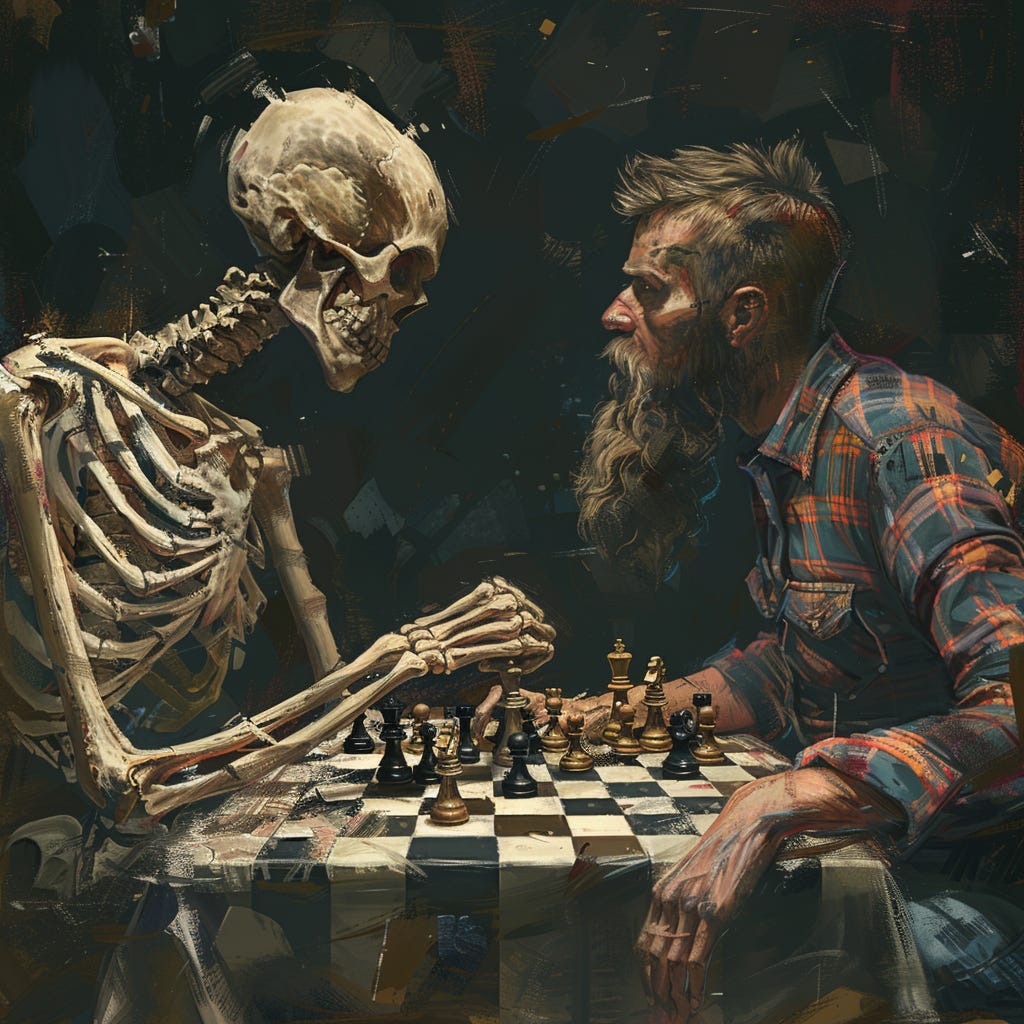
“Are you sure you want to keep playing? You could use a sandwich…”
Chess has always intimidated me. Not least because one minute I’m enjoying my life as double-bacon Paul, filing taxes and running payroll…picking up a dead cat in the backyard AND THEN a dead rat in the backyard (unrelated scenarios, as far as I know…the cat died first and my role was merely the disposal of the bodies). My point is, one moment I’m no warrior, then snap: a flash happens-
I’m suddenly charged with the protection of a King, commanding horse-backed warriors, giving orders to bishops of religion, and rooks and a Queen, sacrificing peasants for the great purpose:
Conversion to my way,
or Death…
More me, Less you.
A clever player needn’t defeat his enemy…he converts them, and he does so by toppling the opponent’s king expediently.
I am not a clever player…yet I’m learning.
The way a piece can move is what makes it interesting. Its specialized function (and correlated limitation). The game takes on aspects of life and its characters, reflecting reality in its rules and dictates.
A bishop moves sideways,
diagonal-
following the slanty line
of the priestly way.
Knights move surprisingly:
leaping L-shaped,
and limited.
Pawns move straight ahead when told to,
and get a boosty in the beginning
(right before they begin to see their friends
laid to rest by the severals, then they slow down).
Understandable.
A Queen moves
anywhere
and directly
when there is nothing to halt her progress.
That is because powerful women
can get anywhere
but arrive in unsafe territory
if moving blindly.
The goal of a good leader
is to open pathways before his Queen
and to protect her
where she goes.
The King is the most valuable piece on the board. This is perplexing because his piece has the strictest possible limitations short of being immobilized completely. He can only move one square in any direction and cannot move himself into a check position (no danger squares). The King is not the Operator…he is the microchip, and a good King seeks victory most convincingly and expediently. He does not desire a bloodied and tattered kingdom…however, if that skanky enemy queen gets anywhere near him, all bets are off and he’ll make the sacrifices necessary for survival.
One can, after all, hire new pawns and priests in the next game of warfare…
I believe I’ve won my first difficult game of Chess today. It’s not that I’ve put ChampsChamps King into checkmate yet, the game is still afoot. I’ve won because I’ve broken the pattern of sacrificing stupidly in reactions. I’ve kept my mind open to opportunities in the arrangement of the game. I’ve begun to assess patterns and employ strategies, to operate as if victory is possible, despite my limitations and the mistakes made along the way.
Chess teaches its players to broaden their vision, coordinate a diverse team, leverage strengths, bolster weaknesses, and remain cucumber cool in the ever-necessary pivot maneuver.
To seek a path to victory, and- more importantly- to find enjoyment in the game while playing.
That’s Chess, lately.
“You made Chess sound interesting and I don’t even like Chess!”
- my Queen, Milena